
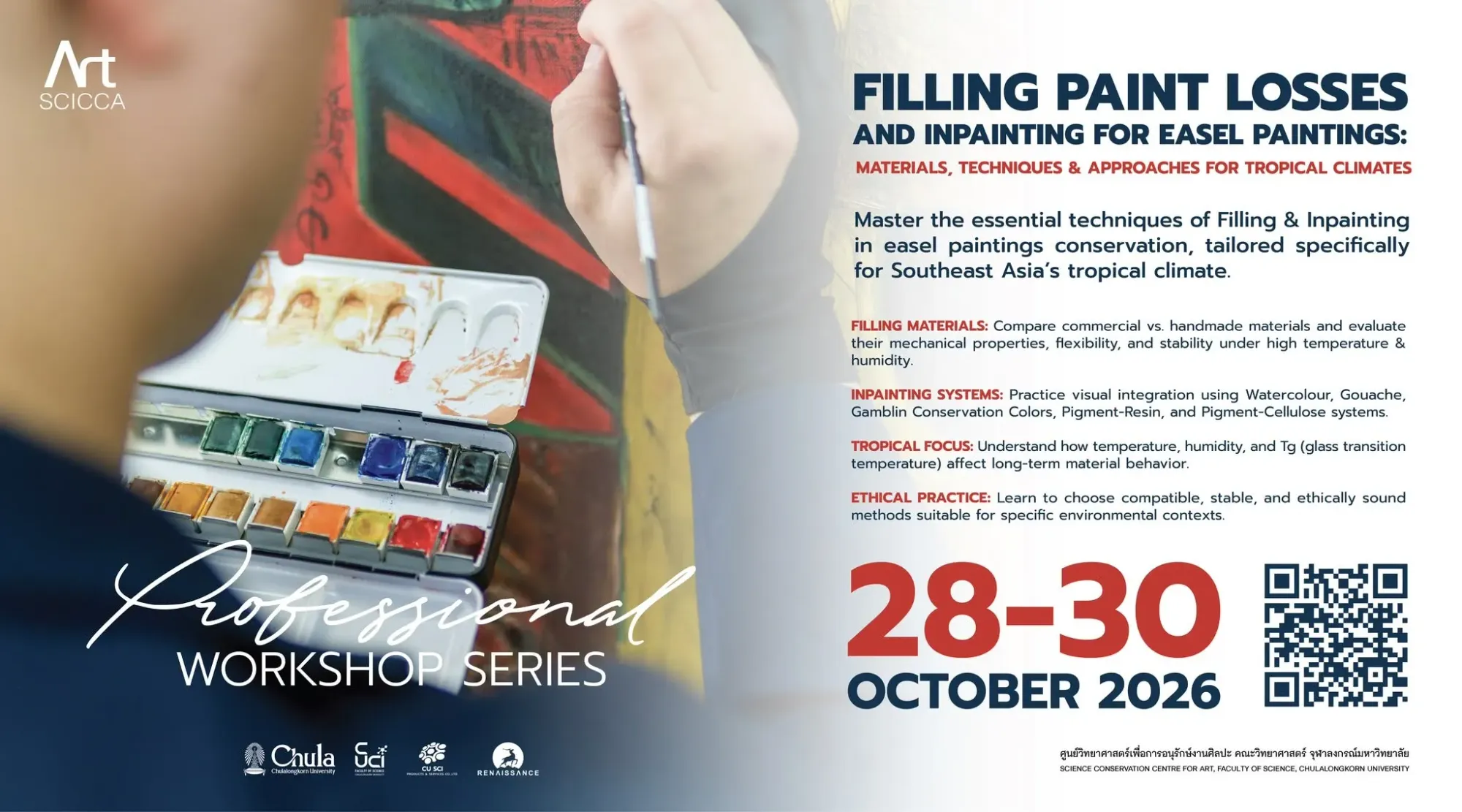
SCICCA Professional Workshop Series: Filling Paint Losses & Inpainting for Easel Paintings: Materials, Techniques & Approaches for Tropical Climates

An intensive, hands-on workshop designed by conservators, for
conservators & emerging professionals across Southeast Asia.
Filling paint losses and inpainting require more than technical skill; they demand informed decisions about materials, ethics, and long-term performance. In tropical climates, elevated temperature and humidity introduce additional challenges that influence the behaviour, stability, and durability of conservation materials.
This intensive three-day workshop combines lectures, demonstrations, and extensive hands-on practice to help conservators develop practical skills while understanding the scientific principles behind material selection and treatment decisions for easel paintings in Southeast Asia.
Why this workshop?
Although filling and inpainting are routinely performed in easel painting conservation, selecting appropriate materials remains challenging, particularly in tropical climates where elevated temperature and relative humidity significantly influence material performance. Many traditional materials and published methodologies were developed in temperate regions and therefore require critical evaluation before being applied in Southeast Asia.
This workshop aims to bridge the gap between internationally established conservation theory and the practical realities of working in tropical environments by integrating conservation science, material behaviour, ethical decision-making, and extensive hands-on practice. Through this approach, participants will gain the knowledge and confidence to select filling and inpainting systems that are technically appropriate, visually successful, and suitable for the environmental conditions of Southeast Asia.
Learning Objectives
By the end of the workshop, participants will be able to:
- Evaluate different filling materials according to their mechanical and
physical properties. - Select appropriate fills for different paint structures and support
types. - Understand how tropical temperature and relative humidity influence
conservation materials. - Compare a range of retouching systems and their advantages and
limitations. - Apply a variety of inpainting techniques according to ethical and
aesthetic considerations. - Develop a personal workflow for filling and retouching easel
paintings. - Select materials that are compatible, stable, and appropriate for
Southeast Asian environmental conditions.
Workshop Information and Registration
When: 28–30 October 2026.
Where: Science Conservation Centre for Art (SCICCA), Painting Conservation Laboratory, Faculty of Science, Chulalongkorn University, Bangkok, Thailand.
Who should attend: Conservators & emerging professionals from Southeast Asia.
Prerequisites: Participants should be familiar with basic conservation principles & ethical considerations, colour theory, & fundamental approaches to the
conservation of easel paintings.
Language: English (all lectures, discussions and workshop materials)
Price:
- Early Bird
- 22,000 Baht / person — For full payment by September 15, 2026
- Regular Rate
- 24,500 Baht / person — Applicants can choose from 2 payment options
- 1) Full Payment 23,000 Baht / person (receive special discount)
- 2) Installment Payment (2 phases)
- Deposit: 4,500 Baht (due by September 30, 2026)
- Remaining Payment: 20,000 Baht (due by October 20, 2026)
- 24,500 Baht / person — Applicants can choose from 2 payment options
The registration fee includes lunch, break snacks and drinks, all materials required for the hands-on workshop, a printed technical reference book, a personal practical kit, personal protective equipments, and a certificate of participation.
Limited to 10 participants to ensure close individual supervision
during practical sessions.
Introduction
Filling and inpainting are among the most visually demanding stages of easel painting conservation. Successful treatment requires not only technical skill, but also informed decisions regarding materials, ethics, and long-term stability.
This intensive workshop introduces the principles, materials, and practical techniques used for filling paint losses and inpainting, with particular emphasis on conservation practice in the tropical climates of Southeast Asia.
Through lectures, demonstrations, and extensive practical exercises, participants will compare commercial and handmade filling materials, evaluate their mechanical and physical properties, and examine their compatibility with original paint layers and supports. Particular attention will be given to how elevated temperature and relative humidity influence material behaviour, including flexibility, moisture sensitivity, glass transition temperature (Tg), and long-term stability.
Participants will then explore a range of retouching systems—including watercolour, gouache, Gamblin Conservation Colors, pigment–resin systems, and pigment–cellulose systems—and practise a variety of visual integration techniques. Throughout the workshop, emphasis will be placed on selecting appropriate methods according to the artwork, viewing conditions, ethical considerations, and environmental context.
By combining scientific understanding with practical experience, participants will gain the confidence to select and apply filling and inpainting materials that are compatible, stable, visually integrated, and suitable for long-term conservation in tropical environments.
Workshop Program
A 24-hour Intensive Program (subject to adjustments) + 1-hour lunch
break:
[Day 1 – Foundations of Filling & Inpainting]
09:00–12:00 Lecture
- Principles of filling and inpainting
- Ethical considerations
- Filling materials and their properties
- Material behaviour in tropical climates
13:00–18:00 Hands-on
- Preparing and applying fills
- Commercial vs handmade filling materials
- Surface finishing and texture matching
[Day 2 – Preparing for Retouching]
09:00–18:00 Hands-on
- Refining fills
- Surface preparation
- Colour matching
- Introduction to retouching systems
- Practical exercises
[Day 3: Retouching & Inpainting]
09:00–17:00 Hands-on
- Tratteggio
- Rigatino
- Puntinato
- Astrazione cromatica
- Selezione cromatica
- Neutral retouching
- Mimetic retouching
17:00–18:00 Discussion and Certificate Presentation
Workshop Materials & Takeaways
By the end of the workshop, each participant will take home a personal reference and practice kit, including:
- A filling materials sample board featuring different commercial and handmade fillers, prepared and applied by the participant during the hands-on sessions.
- An inpainting techniques sample board documenting different retouching techniques, materials, and approaches explored during the workshop.
- A completed inpainting exercise, independently carried out by the participant, demonstrating the application of selected retouching techniques.
- A selection of resin and pigment samples for participants to experiment with and develop their own personal retouching palette, together with a ceramic colour-mixing palette and an empty-pans palette for preparing, organizing, and storing retouching colours.
- A practical material reference collection that can be used for future comparison, testing, and conservation practice.
- A Technical Reference Materials book with filling materials and their properties, inpainting materials and systems, application techniques, environmental considerations for tropical climates, recommended suppliers and sources, bibliography and further reading.
- A certificate confirming participation in the 24-hour intensive hands-on workshop.
Approximately 80% of the workshop is dedicated to practical, hands-on training, allowing participants to develop techniques through guided exercises, demonstrations, and individual practice.
Instructor
Norman Verschueren is a Belgian Easel Paintings Conservator (BA, MA) and currently serves as Graduate Fellow in Science for Industry and Head of the Paintings Conservation Laboratory at the Science Conservation Centre for Art (SCICCA), Faculty of Science, Chulalongkorn University, Bangkok.
His research focuses on the conservation of modern and contemporary paintings, the behaviour of conservation materials in tropical environments, innovative conservation technologies, and values-based conservation through community and stakeholder engagement within Southeast Asian cultural heritage.